Introducing Tide: your liquidity, managed by an AI agent

Providing liquidity means making decisions: where to place a price range, how wide to make it, and when moving it is worth the cost.
Tide brings those decisions into an AI-managed vault.
We’re preparing to open public liquidity vaults for Stock Tokens on Robinhood Chain. Users deposit USDG, receive vault shares, and let an agent manage the liquidity position within defined on-chain limits. The dashboard makes its decisions and execution visible.
The goal is simple: make active liquidity management easier to access and easier to inspect.
Why active management matters
Concentrated liquidity earns swap fees while the market price stays within a selected range. Outside that range, the position stops earning swap fees until the price returns or the liquidity is repositioned.
Narrower ranges concentrate capital but may require more frequent adjustments. Wider ranges give prices more room to move. Every adjustment has costs, so moving more often is not necessarily better.
Tide’s agent evaluates these tradeoffs using on-chain price and volatility data alongside US market-session context. Sometimes it adjusts the position. Sometimes it holds.
You deposit. Tide manages.
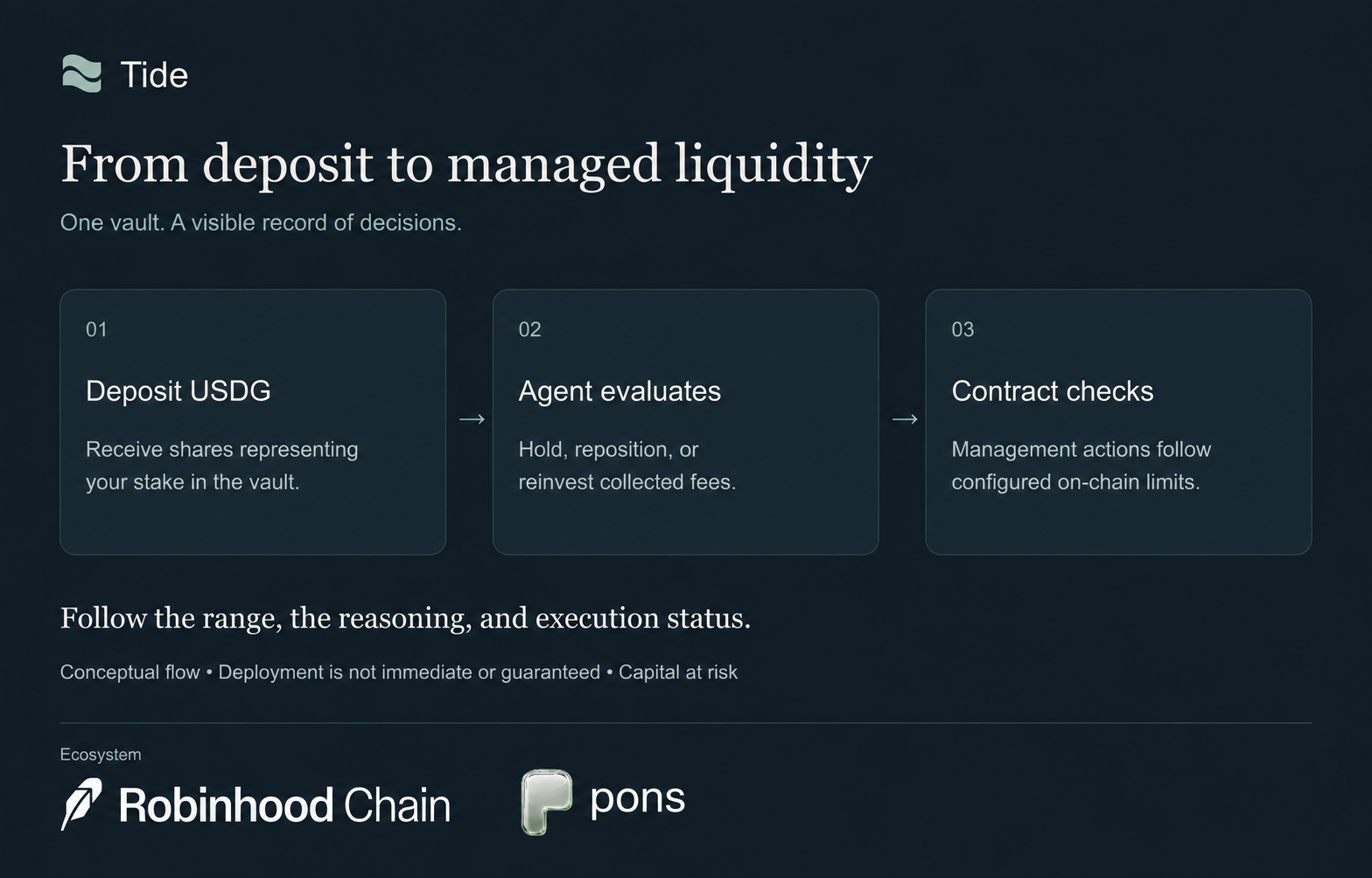
Choose a vault, approve USDG, and deposit. You receive shares representing your proportional stake in the vault’s holdings.
Each vault manages one concentrated-liquidity position. The agent can convert part of the idle USDG into the paired Stock Token, deploy liquidity, adjust its range, and collect and reinvest fees.
Deployment depends on market conditions, the agent’s operating status, and contract checks. Deposits are not necessarily deployed immediately.
See the decision and the result
The dashboard shows the current range, market price, recent decisions, the agent’s stated reasoning, and execution status.
A proposed adjustment is different from a completed transaction. Tide shows both, so users can compare what the agent intended with what happened on-chain.
That record is central to the product: users should be able to follow and assess the management of their liquidity.
Understand the permissions and risks
The agent can deploy and reposition liquidity and compound fees. Its management permissions do not authorize it to withdraw other depositors’ shares.
Contracts check rebalances against owner-configured limits, including range width, cooldown, swap slippage, and price deviation from a time-weighted average.
The owner retains administrative powers: changing the agent and limits, pausing operations, and rescuing tokens held by the contract. These powers remain part of the trust model.
Withdrawals burn vault shares and return proportional holdings in the vault’s current token mix, which may include both USDG and the Stock Token.
Tide is unaudited. Liquidity positions can lose value, and fees do not guarantee a positive overall return. Estimated fee APR is not a forecast of depositor returns. On-chain limits do not eliminate management or smart-contract risk.
What comes next
We’ll share public-access details and walkthroughs showing how the vaults operate, how the agent makes decisions, and how users can inspect the results.
Your liquidity. Managed by an AI agent.